
OceanX Sixgill Shark Video and Its Original Source
The OceanX sixgill shark video shows a large female investigating Nadir’s observation window during a June 2019 dive in the Bahamas. The Florida Museum links to OceanX’s video in its original expedition coverage. OceanX also published a five-second excerpt in 2023.
Updated
OceanX’s five-second clip
The embedded excerpt was posted by OceanX on February 24, 2023. For the earlier footage, use the OceanX post cited by the Florida Museum.
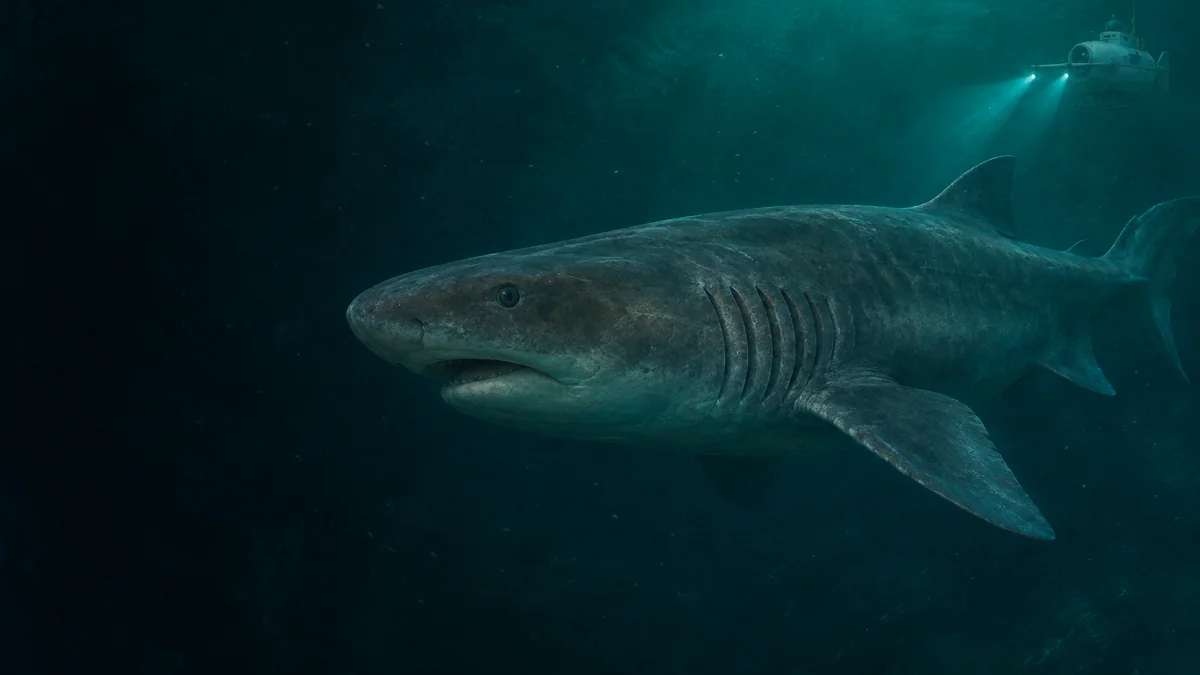 Editorial illustration
The embedded player loads from TikTok when you select it.
Which version of the OceanX sixgill shark video to watch
Start with the link in the Florida Museum's July 2019 expedition story if you want the earliest traceable version listed here. The museum points directly to a Facebook post by OceanX. Its story identifies the dive team and explains the research objective. Save the museum article alongside the video link if you plan to cite the encounter, because the article gives a reader enough context to identify the dive even if the player stops working.
The TikTok player above opens a separate five-second excerpt posted by OceanX on February 24, 2023. It is a quick view of the shark at the window. To cite that exact social cut, use its TikTok address and publication date. Look for the account name and date on the platform if the same post appears in a news embed or a third-party compilation.
OutKick's November 22, 2026 article describes a circulating cut and calls attention to the eye at about 52 seconds. If that was the detail you came to find, use the report alongside the frames where the animal turns beside the sphere. The two OceanX links on this page serve different viewing needs, and the article supplies the timing reference for the reported cut.
A viewing guide to the pass by Nadir
Follow the edge of the window as the shark moves in. It is a fixed reference against which you can see the direction of the pass. The female's head is broad and flattened, so the front of the snout can occupy much of the visible area before the rest of the body comes into view. A view from the side is better for seeing the relationship between her head and the body than a head-on view.
Watch the transition from the close approach to the turn. The light can make the eye look unusually bright for a moment. The Florida Museum's species profile describes green eyes in living bluntnose sixgills. The shade in a video frame also depends on the position of the lamp, the water between the animal and lens, and the color processing in the copy you are watching.
The gill slits and rear dorsal fin are more useful for identifying the species when the video shows enough of the body. A close clip may crop out those features. If your version only shows the snout and eye, use the expedition team's species identification together with the longer record. Keep the frame that shows the approach separate from an image credited to a different dive or a general stock photograph.
Why the shark can look larger in one frame
An animal passing close to a camera covers more of the frame with the same physical length. The view through a curved observation sphere adds another reason to avoid taking a measurement from a screenshot. A usable measurement would require a reliable reference at the animal's distance, a known relationship between that reference and the lens, and a view of both ends of the shark. The brief close-up rarely gives a viewer those conditions.
The Florida Museum report describes a female estimated at about 16 feet. OutKick later gives a range of 16 to 17 feet. Converting those values gives approximately 4.9 to 5.2 meters. When sharing the clip, attribute the estimate to the account you used. Copying a headline's upper value as an exact length introduces precision that the reporting never claimed.
Where the satellite tag fits in the video story
The female visible by the window and the male fitted with the tag are separate sharks in the Florida Museum's record. The team was on the dive to study the species, which put the observations in the same expedition account. Gavin Naylor deployed the tag on a male, and the museum places that event at more than 1,700 feet below sea level.
The scientists later checked footage to confirm that the tag had attached to the male. That review had a specific research purpose, while the close-up of the female documents how she moved around the craft. If a short compilation presents both moments together, a useful caption identifies which shark appears in each observation. It also keeps the recorded tagging depth separate from any claim about a particular frame.
Earlier coverage of the OceanX sixgill shark video
Newsweek reported on the encounter in August 2019. Its account names Nadir, describes the crew’s reaction to the female and quotes researcher Gavin Naylor on the species. It provides a description of the footage close to the time of the expedition. Outdoors covered the material again in May 2025 and described it as recirculating, well before OutKick’s November 2026 story.
The reports also tell you which source to open for different details. The museum records the date of the dive and the tag placement. Newsweek gives an early account of what the crew said while watching the female. OutKick documents the later retelling and the timestamp it highlighted.
Check the photo credit as well as the video credit
The header photograph in the Outdoors article is credited to Ralph White and captioned as a sixgill investigating the MIR I submersible in 1990. The subject of that article is still the OceanX footage from 2019. A picture of a related encounter can therefore appear beside a video from a different craft and date. Check the credit for the name of the vessel and the year before using a still image to identify Nadir.
The poster on this page is an editorial illustration. For details visible on the June 2019 dive, follow the recording links above. In the video itself, the movement of the animal across several frames can help you distinguish a view of the head from a cropped view of the whole pass.
How to share or cite the footage
Link straight to the OceanX post when you can. Include June 2019 as the filming period and use the video's own platform date for the version you cite. If you point to a timestamp, name the cut you viewed. The five-second clip and the version discussed by OutKick cannot use the same elapsed time.
Keep the location at the level of Exuma Sound off Eleuthera in the Bahamas. The expedition sources give enough information to locate the study area. A precise filming coordinate, a shot-by-shot depth, and the first upload date for every circulating edit remain separate details for which the public accounts offer limited evidence.
Sources
- OceanX on Facebook — footage of the diveThe OceanX post linked directly from the Florida Museum's 2019 expedition account.
- OceanX on TikTok — sixgill shark at the submersible windowA five-second excerpt published by OceanX on February 24, 2023.
- Florida Museum — Florida scientists tag deep-sea shark from submersibleJuly 2019 account with participant interviews, the 2019 dive record and a link to OceanX footage.
- OceanX — We Tagged a Bluntnose Sixgill Shark (Finally!)July 1, 2019 mission account covering earlier attempts, the Bahamas team and the successful tag.
- OutKick on Fox News — Massive 17-foot shark comes face-to-face with scientistsNovember 22, 2026 coverage documenting renewed circulation and the later headline estimate.
- Florida Museum — Bluntnose Sixgill Shark (Hexanchus griseus)Species reference for field marks, habitat, geographic distribution, behavior and size context.
- Newsweek — Scientists film a bluntnose sixgill from NadirContemporaneous reporting describing the female in the footage and interviewing expedition researchers.
- Outdoors — Rare footage of a deep-sea sixgill sharkEarlier coverage with a separately credited 1990 photograph in its header.