Exuma Sound · June 2019

OceanX Submersible and the 2019 Sixgill Shark Encounter

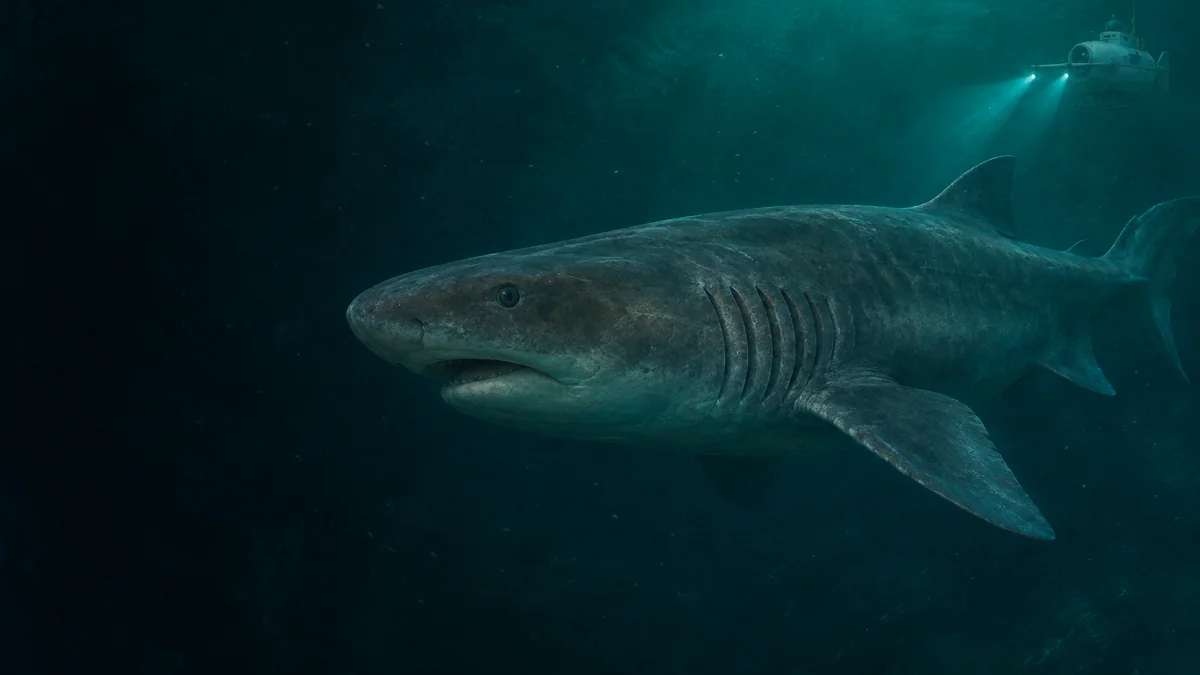
A bluntnose sixgill shark approached the window of the OceanX submersible Nadir during a 2019 research dive in the Bahamas. The footage circulated again in November 2026. The expedition record shows what the crew saw and how they tagged a different shark at depth.

Editorial illustration
Dive recorded
29 June 2019
Location
Exuma Sound, Bahamas
Submersible
Nadir · Triton 3300/3
Recorded tagging depth
Over 1,700 ft

The encounter

What happened on the OceanX submersible dive?

Nadir descended off Eleuthera on the last night of a June 2019 field effort. The three-seat craft was launched from the research vessel Alucia and settled near a shelf in deep water. The Florida Museum account describes a large female bluntnose sixgill making a close pass around the submersible and investigating its window.

The expedition had come to Exuma Sound to test whether a satellite tag could be fitted at the shark’s normal depth. On the successful dive, researcher Gavin Naylor deployed a tag on a male sixgill. The researchers later checked video to confirm the tag was in place. The visit by the larger female is the moment most viewers recognize from the clip.

Three numbers tell different parts of the story. About 16 feet is the museum’s estimate for the female. More than 1,700 feet is the recorded depth of the tagging. The submersible’s 1,000-meter rating is a specification of the craft. Converting all three figures is straightforward, but using the rating as the dive depth would misread the expedition record.

The OceanX submersible carried the pilot and observers down from Alucia. The ship remained at the surface while the pilot positioned Nadir near a ledge. From there, the window gave the crew a view of the animals moving close to the sloping seafloor, a part of the encounter a short clip leaves out.

A separate survey in 2018 helps explain the choice of site. Researchers working from Alucia found a rocky wall that gives way to a steep slope off Eleuthera. They could reach deep habitat relatively close to shore. That geography matters to the 2019 encounter because it put the OceanX submersible near the terrain where the field team expected sixgills to pass.

Encounter record
FieldDetail
DiveJune 29, 2019, off Eleuthera in Exuma Sound Florida Museum
CraftNadir, launched from the research vessel Alucia Florida Museum
SpeciesBluntnose sixgill shark (Hexanchus griseus) Florida Museum species profile
Female at the windowAbout 16 ft (4.9 m) in the museum account Florida Museum
Male taggedAt more than 1,700 ft (about 518 m) Florida Museum
Vehicle rating1,000 m (about 3,280 ft) for the Triton 3300/3 Triton Submarines
Editorial illustration of a broad-headed sixgill shark passing a submersible light in deep water Editorial illustration

Original footage

Watch the sixgill shark at Nadir’s window

The Florida Museum’s 2019 article links to OceanX’s own video of the dive. The video archive brings that source together with a brief clip posted by OceanX in 2023. You can use either to get oriented and then read the expedition account for the details the camera cannot establish.

Look for the wide snout as the female comes alongside the viewing sphere. At close range, the lights catch her eye. The size of the animal is an estimate from people on the expedition, and the apparent scale changes as it swims towards the lens.

Open the video archive

The chronology

From the 2019 dive to the 2026 coverage

A clip can acquire a new headline each time it circulates. The useful dates are the dive itself, early records that place the footage in context, and the date of the later report. The timeline keeps those events in order so the footage can be traced back to the research trip.

The early mission account supplies details a short edit rarely shows: an earlier field test, unsuccessful dives, a night when no sharks appeared, and the final attempt. The work involved a ship, a pilot and a group of researchers, even when the camera was trained on one animal.

Read the video fact check
  1. Nadir dives off Eleuthera

    The Florida Museum records a large female near the craft and a satellite tag placed on a male at more than 1,700 feet.

  2. OceanX documents the expedition

    The team posts its account of tagging a deep-sea shark from a submersible. The museum follows with its own account and a link to footage.

  3. OceanX shares a short excerpt

    The organization’s TikTok account posts a five-second look at a bluntnose sixgill inspecting its submersible.

  4. The clip draws new coverage

    OutKick’s report describes the animal as 16 to 17 feet long and identifies the dive as a 2019 encounter.

Explore the archive

The OceanX submersible, the shark and the expedition

Each archive entry follows one part of the encounter. The technical record explains the craft, the species profile gives context for the close-up, and the expedition timeline shows how a field team gathered evidence at a depth unreachable by most observers.

Research vehicle

The Nadir submersible

Nadir gave its pilot and observers a direct view through a large clear sphere. Its connection to Alucia matters: the ship transported the submersible and supported the team at the surface. The Nadir entry puts the rated depth, crew arrangement and role on the dive side by side.

Species profile

Bluntnose sixgill shark

Look for a broad head, six gill slits on either side and one dorsal fin far back. The species ranges through tropical and temperate seas. Its use of deeper water and slopes helps explain why a manned submersible could observe an adult that people at the surface rarely see.

Field research

The 2019 tagging expedition

The researchers wanted to record depth, light and temperature after the shark continued swimming in its own habitat. The tag was designed to detach and transmit from the surface. The field record describes what the expedition achieved and what the instrument was expected to measure.

Common questions about the encounter

Which OceanX submersible is in the shark footage?

The submersible was Nadir, a Triton 3300/3 operated from Alucia. The model carries a pilot and two passengers. Triton lists a depth rating of 1,000 meters.

When and where was the OceanX shark video filmed?

The encounter dates to June 2019 off Eleuthera in the Bahamas, in Exuma Sound. The Florida Museum records a June 29 dive. OceanX’s 2019 mission account predates the November 2026 coverage by more than seven years.

How big was the shark by the viewing window?

The Florida Museum described a female of about 16 feet, or 4.9 meters. The November 2026 OutKick story reported 16 to 17 feet, or roughly 4.9 to 5.2 meters. Those figures are estimates.

How deep did the team see sixgill sharks?

The museum puts the successful satellite tagging at more than 1,700 feet, a little over 518 meters. The record supports that depth for the tagged male. It does not supply a separate depth reading from each shot of the female.

Did the researchers tag the female in the video?

The Florida Museum describes two animals in its account. The female inspected the window. A male received the satellite tag on the successful dive. Her close pass and his tag are separate observations.

Why was the video in the news again in 2026?

OutKick covered the recirculating clip on November 22, 2026. The article explicitly dated the encounter to 2019. The original mission records and an OceanX excerpt from 2023 show that the footage was public years before the renewed coverage.

What could the tag deployed from the OceanX submersible record?

The satellite tag was designed to log depth, ambient light and water temperature for about three months. The plan was for it to detach and transmit once it reached the surface. Those readings could describe the male shark’s use of different layers of water after the expedition ended.

Read all encounter questions

Sources

  1. Florida Museum — Florida scientists tag deep-sea shark from submersibleJuly 2019 account with participant interviews, the 2019 dive record and a link to OceanX footage.
  2. OceanX — We Tagged a Bluntnose Sixgill Shark (Finally!)July 1, 2019 mission account covering earlier attempts, the Bahamas team and the successful tag.
  3. Triton Submarines — Nadir and the Triton 3300/3 in Blue Planet IIManufacturer background on the original 3300/3 model, Nadir and its use aboard Alucia.
  4. OceanX on Facebook — footage of the diveThe OceanX post linked directly from the Florida Museum's 2019 expedition account.
  5. OceanX on TikTok — sixgill shark at the submersible windowA five-second excerpt published by OceanX on February 24, 2023.
  6. OutKick on Fox News — Massive 17-foot shark comes face-to-face with scientistsNovember 22, 2026 coverage documenting renewed circulation and the later headline estimate.
  7. Florida Museum — Bluntnose Sixgill Shark (Hexanchus griseus)Species reference for field marks, habitat, geographic distribution, behavior and size context.
  8. Mongabay — Underwater tech unlocks the secrets of The Bahamas’ Exuma SoundReporting from earlier Exuma Sound work with the Cape Eleuthera Institute and Alucia.